

Focus on Leadership: Malisa Maynard’s passion for conservation, reuse and inclusion is rooted in her childhood in Montana – July 2026
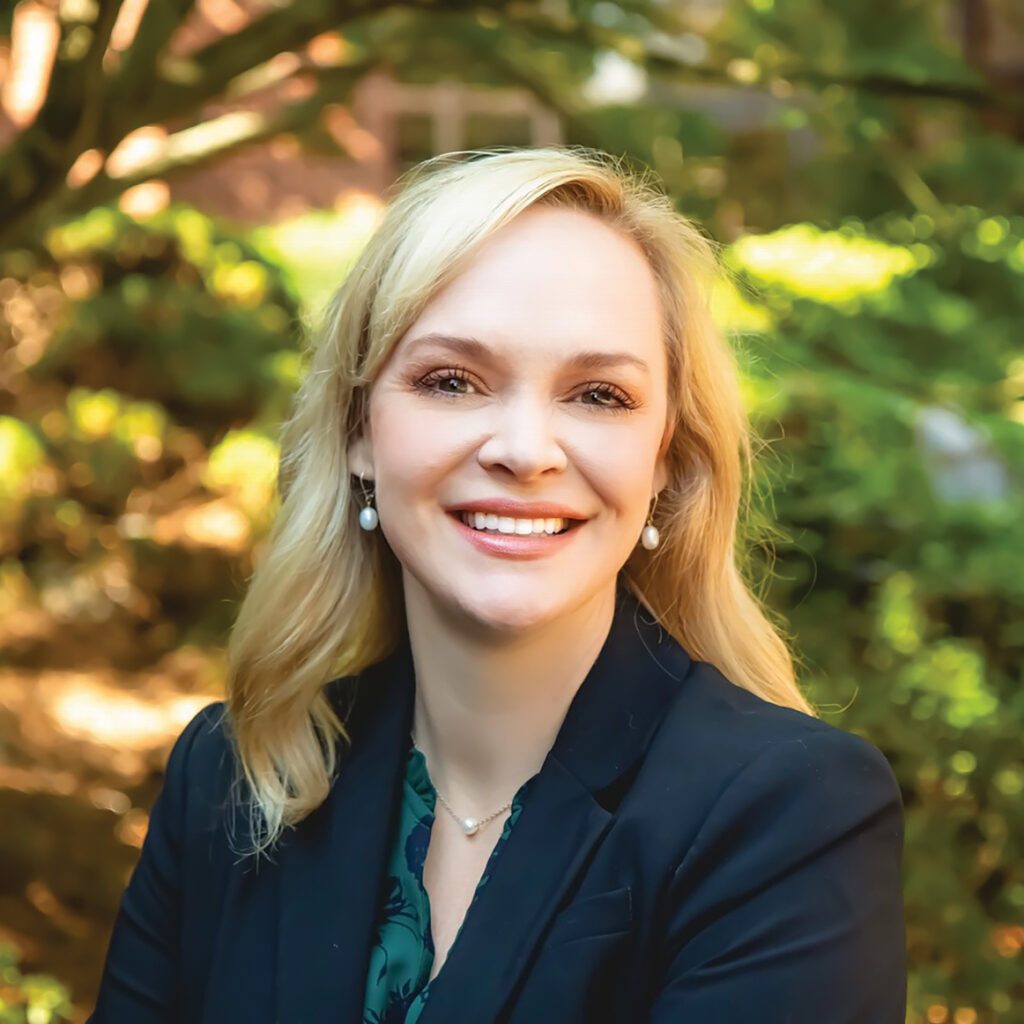
Interview by Kemp Harr
As chief sustainability officer for Mohawk Industries, Malisa Maynard oversees sustainability strategy for the world’s largest flooring manufacturer, helping guide the company’s efforts in circularity, material transparency, responsible manufacturing and long-term environmental stewardship.
Since joining Mohawk in 2021, she has worked across the global organization to advance initiatives that reduce environmental impact while supporting business growth and product innovation.
With a background in environmental engineering and years of experience improving manufacturing operations, Maynard brings a practical, systems-based approach to sustainability—one grounded as much in operational performance as in environmental responsibility.
Q: How did growing up in Montana influence the career path that you’ve chosen?
A: Growing up in Montana taught me about living in relationship with the land. My great-grandma Violet built her house on the banks of the Bitterroot River and raised her family with a focus on conservation and reuse, not as a philosophy but because it was essential for survival. My grandpa Phil worked in the forest his entire life and genuinely loved it. My dad followed him into the sawmill for more than 50 years with a similar awe for the regenerative power of woodlands. Curiously, those principles weren’t taught in a classroom; I just observed how life worked and embraced stewardship as a natural extension of our family’s story.
My family was tight-knit and encouraged my siblings and me to pursue our dreams. I grew up with a brother and sister who used wheelchairs. When we went to town, I always wanted people to see them the way our family did—as remarkable people, full stop. That shaped how I think about inclusion just as much as the land shaped how I think about stewardship. Today, both inform who I am as a leader and as a person.
Q: How has your degree in environmental engineering helped you be more successful in your role?
A: Engineering gave me a systems lens. Before I was ever thinking about strategy or communications, I was optimizing processes on the plant floor. I was tasked with finding where waste lived, where water was being used inefficiently, and where energy was being lost. That operational grounding makes me a more credible sustainability leader because I’ve spent countless hours in manufacturing facilities. I understand what’s actually hard to change and what’s just inertia, and I respect the great work people contribute to a business every day. It also makes me impatient with sustainability that lives only in reports. Data is only as important as the positive changes it drives. Our world is overwhelmed with data. I look for the key metrics and use them as a catalyst for facilitating conversations that can spark a change.
Q: What led to you taking the role at Mohawk to lead their sustainability initiatives?
A: Scale matters in sustainability. Mohawk is the global leader in flooring manufacturing (the second largest in the U.S.), with operations in 19 countries and thousands of products, the vast majority of which were developed with sustainability in mind. That scale means the work has real consequence in both directions. With the complexity and size of the business, the challenges are significant, but so is the potential for impact. When I joined Mohawk in 2021, I knew I wasn’t being asked to create or rebuild a sustainability program. I could see that the conservation ethic was already embedded in the culture. During my first week, I came across an archived Mohawk repair job ticket from 1947 stamped “Use Less! Waste Less!” I thought, this is an organization that’s been building toward something for a long time. I wanted to be part of the team that could accelerate progress, and I’ve been delighted with how it’s worked out.
Q: What are the biggest challenges the flooring industry faces to offer a more circular product solution?
A: The single biggest barrier to circularity in flooring is what happens at the end of a floor’s life. Right now, the honest answer is not enough. The collection and recovery infrastructure simply doesn’t exist at the scale the industry needs. Compare that to our ability to repurpose plastic bottles into polyester fiber. We have a reliable recycling infrastructure that supports our needs. We can’t make that process work without them. We know how to make better products, and we continuously push the envelope in that regard. We’ve raised the bar on material transparency and design. But if we can’t get the product back at the end of its useful life, we can’t close the loop.
There’s been more progress in commercial flooring than residential, but around three fourths of flooring is residential. This is a shared industry problem, not just an issue for manufacturers, and it requires shared industry commitment to a solution, including logistics, sortation and processing. I’m encouraged that the conversation is shifting. We’re seeing more willingness among manufacturers, specifiers and value chain partners to treat recovery as a collective responsibility — and that’s where real progress is made.
Q: What do you see as the biggest sustainability challenge facing the flooring industry today?
A: The biggest challenge is also one of our biggest opportunities: closing the gap between aspiration and accountability. The good news is that tools like EPDs, LCAs and robust third-party certifications are in place, and more companies are using them seriously than ever before. I’d love to see the industry embrace transparency, not as a compliance exercise but as a shared commitment to doing better. When we’re honest about where we are and clear about where we’re going, we build trust with specifiers, with retailers, with end users and with each other. That’s the foundation a truly sustainable industry is built on together.
Q: Where is the industry making the most progress, and where is it falling short?
A: The most genuine progress is happening in material transparency. More companies are publishing EPDs, using Declare labels and engaging seriously with certifications like the Living Product Challenge. That’s real. Where we’re falling short is on systemic circularity and Scope 3 emissions. Individual product achievements are meaningful, but the supply chain—from raw material extraction, chemicals, logistics, etc.—is where the deeper work lives. I’m excited that industry attention is starting to turn in that direction.
Q: How important is onshoring in the whole sustainability equation?
A: It matters more than many sustainability frameworks currently account for, possibly because in some instances businesses don’t have a domestic supply model as an alternative. Supply chain resilience, transportation emissions, labor standards and community economic stability are all sustainability issues, not just operational ones. Mohawk’s U.S. manufacturing facilities are in small towns, which means that the vitality of those communities is directly tied to how we run our business. That’s a responsibility all of us take seriously.
We’re proud that most of the products we sell in the U.S. are made in the U.S. Onshoring, when it’s paired with genuine investment in workers and communities, is good for the supply chain, and it’s part of what a regenerative economy actually looks like.
Q: What were the pivotal moments that shaped your leadership style?
A: Growing up with siblings who were managing disabilities taught me early that leadership is more about ensuring all voices are heard rather than being the loudest voice in the room. Professionally, the moments that shaped me most were the ones where I had to deliver an uncomfortable truth to a leadership team, particularly at a time when their attention was on other aspects of the business. I learned to do that with both clarity and respect and without softening the facts. Doing that without damaging relationships is a skill I’ve had to nurture through experience.
Q: Who were the most influential mentors in your career, and what did they teach you?
A: The mentors who shaped me most weren’t always the ones with the biggest titles. Some of the most important lessons came from plant managers and process engineers who had spent decades figuring out how things actually work. They taught me to respect the people doing the work, to never lead from a distance, and to understand that lasting change happens through relationships, not mandates. That’s stayed with me at every level. It’s amazing how much more you can accomplish by asking people to share their insights and opinions instead of rushing in with a proposed solution based on abstract data alone.
Q: What traits do you look for when hiring team members?
A: Intellectual honesty first. I need people who’ll tell me what’s true, not what they think I want to hear. After that, curiosity is essential. Sustainability is a field that keeps moving, and the people who thrive in it are the ones who genuinely want to understand how things work and why, as well as how, they could work even better. Finally, I’d say resilience, because this work requires a long-term view. While there are incremental milestones to celebrate, you’re rarely in a position to declare victory and move on. You have to be built for the sustained effort.
Q: What advice would you give young women entering the flooring business today?
A: Learn the entire business versus focusing on building depth within a specific function. The more you understand manufacturing, supply chain, finance and design, the more effective you’ll be and the more seriously you’ll be taken in rooms where decisions are made. Sustainability leadership that doesn’t understand how the business works is advocacy. Sustainability leadership that does understand how the business works is strategy.
If your perspective is limited to the discipline where you work, you’re viewed as an advocate for that function. If you have a more holistic view of the business, you can offer a more strategic perspective that can facilitate consensus building and drive positive change. Always aim for strategy.
Q: What habits or routines make you more effective?
A: Time in nature, whenever I can get it. It’s not incidental to the work; it’s part of how I think. When I’m outside, whether that’s visiting family in Montana, taking a vacation or just stepping away from a screen for a walk outside, I come back clearer and more grounded. The other thing that keeps me sharp is staying curious about fields outside my own. I follow what’s happening in biomimicry, design, materials science and regenerative agriculture. Some of my best thinking has come from connecting dots across disciplines that don’t usually speak to one another.
Q: If you could give your younger self one piece of career advice, what would it be?
A: Your unique perspective is an asset, not a liability. I spent the first years in my career trying to fit into frameworks that weren’t built for me. The things that made me feel like an outsider—growing up rural, coming from a working-class family, thinking about nature and community the way I did—turned out to be exactly what made me effective. Trust it sooner and encourage those who also have alternative perspectives to do the same.
Q: What accomplishments are you most proud of?
A: The progress that doesn’t make headlines. I’ve been doing this work since before sustainability was a corporate priority or even a distinct function within a business. While it’s gratifying to have work recognized with awards, what I’m proudest of is the incremental improvements made by hard-working people who chose to do the right thing. When we execute better water management on a plant floor, a process change that reduced waste nobody thought was reducible, a goal achieved by a team that quietly did the hard work to get there when no one was watching—those wins accumulate into something meaningful that lays the groundwork for further positive change. I’m proud of being part of that, and of helping build teams who carry it forward.
Q: How do you balance your time between your focus on sustainability and your family life?
A: I think about it less as balance and more as integration. My values don’t shift between my family and my career. Whether in my family or at Mohawk, I’m focused on long-term thinking, care for what you’ll leave behind, responsibility to others. I grew up watching my family practice stewardship without calling it that. The actions others see us take send more lasting messages than words alone. My hope is that I’m doing the same thing now, just in a different context. The work matters more when it’s personal. And for me, it’s always been a personal passion.



Join Our Newsletter
Get the latest flooring industry news delivered weekly.